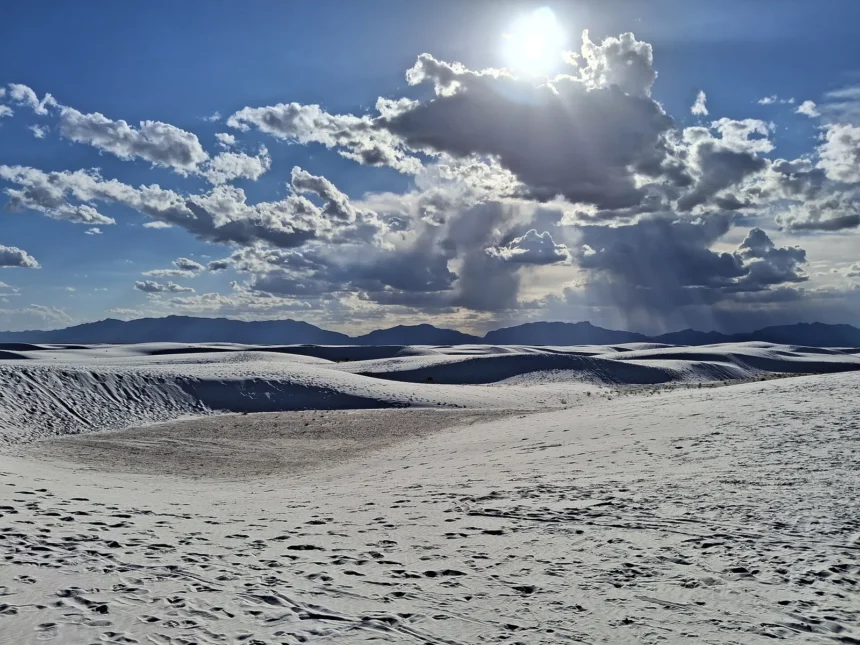
They are the footprints that rewrote the history of the Americas: human tracks, alongside those of giant sloths and mammoths, preserved in the gypsum flats of White Sands, New Mexico, and dated to the height of the last Ice Age. Now research published in Science Advances examines the world those feet walked through, and finds it was anything but stable.
The footprints sit on the former shore of Lake Otero, a large Ice Age lake that filled the Tularosa Basin during the Last Glacial Maximum. By coring the old lakebed sediments and dating their layers, scientists reconstructed how the lake and its surroundings behaved across the very centuries when people were present, and the record shows abrupt environmental change rather than slow, gentle drift.
Reading the lake’s diary
Lake sediments are a diary written in mud. Layers rich in certain minerals and microfossils indicate deeper, fresher water; other layers signal shallows, salinity or dry playa. Radiocarbon dates from organic material in the cores tie each entry to a period, letting the team watch Lake Otero expand, contract and change character over time.
Crucially, the transitions in that diary are sharp. Conditions that supported a productive lakeshore, with fish, waterbirds, game animals and edible plants, could give way comparatively quickly to harsher states. For a small community, that is the difference between a reliable homeland and a landscape that must be re-learned by each generation. The study is published in Science Advances.
People in a moving landscape
Archaeologists sometimes picture Ice Age life as slow adaptation to a slowly changing world. White Sands now argues the opposite: the people who left those tracks were already coping with environmental surprises, moving camps, shifting hunting grounds and renegotiating their relationship with the lake as it changed. Their persistence through those swings is part of why the site matters; it records resilience, not just arrival.
The footprint trails themselves add human detail to the climate record. Adults and children walked the shore, sometimes alongside the giant ground sloths whose tracks cross theirs. Science features like this one sit comfortably beside very different evidence stories we cover, such as Classroom Smartphone Bans Lift Results in Study of 16,000 Students: in both cases, careful measurement revises a story people thought they knew.
What happens next at White Sands
The team wants a denser grid of cores across the basin to test whether the abrupt shifts struck everywhere at once or rippled across the lake system, and finer dating to measure exactly how fast a transition could unfold. Each answer sharpens a bigger question for climate science: how quickly can a landscape flip, and how do people, then and now, reorganise when it does? White Sands, a place defined by tracks in mud, keeps supplying the evidence one layer at a time.
How the finding travels beyond archaeology
Results like these circulate well beyond one discipline because they calibrate expectations. Climate scientists use well-dated abrupt events to test whether their models can reproduce the speed of real change; ecologists cite them when assessing how quickly modern species assemblages might reorganise; and historians of technology note that the entire reconstruction rests on instruments, coring rigs, mass spectrometers, survey lidar, that did not exist when the footprints were first reported.
For general readers, the durable takeaway is simpler. The deep past was not a slow-motion film. It contained shocks, surprises and rapid reorganisations, and the humans who met them were neither passive nor doomed: they adjusted, repeatedly, with the knowledge available to them. White Sands now documents that adjustment in unusual detail, and each new core refines the account of how a community reads a changing landscape and decides, again and again, how to live in it.